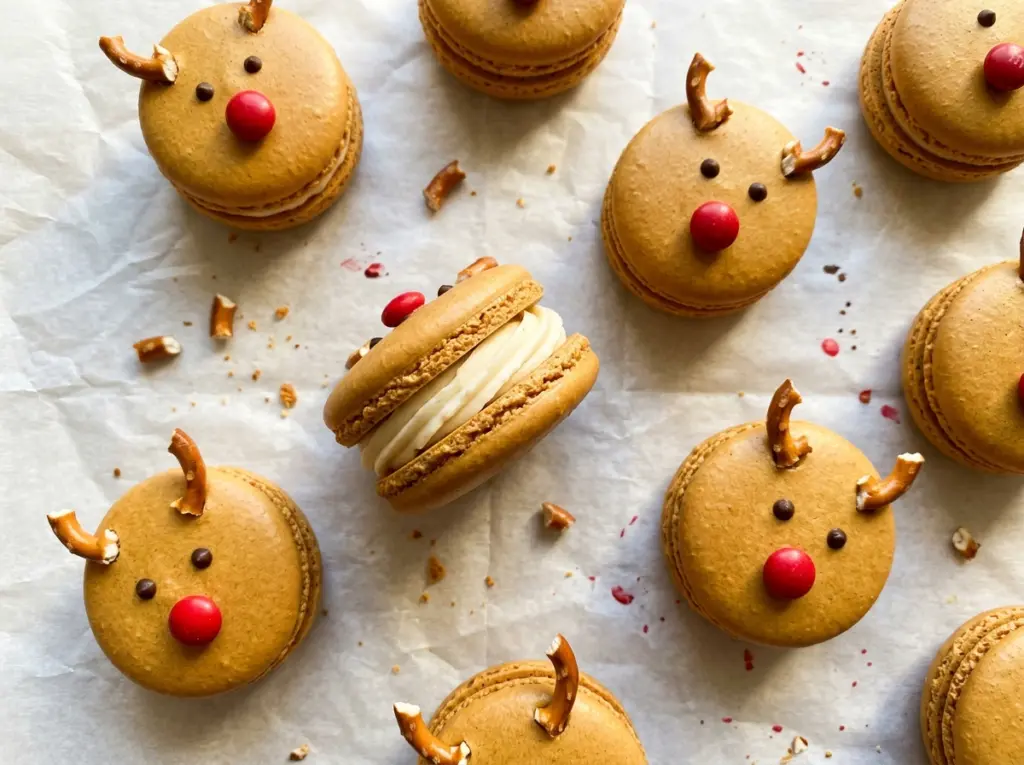
The moment these macarons look like reindeer is when the little red nose goes on, but the shells decide whether the project succeeds much earlier. A smooth top and a neat ruffle at the base give you a sturdy little sandwich for chocolate filling and icing details. I make the shells a warm brown, then keep the decoration simple: two eyes, a red candy nose, and antlers piped with brown icing. The finished batch makes 24, so the faces stay small and the details are easy to place.
Macarons reward careful mixing more than complicated ingredients. I use superfine blanched almond flour and sift it with powdered sugar to keep coarse flecks out of the batter. Room-temperature egg whites go into a clean, grease-free bowl, where cream of tartar helps them whip into a glossy base. The brown gel coloring goes in before the dry ingredients, so the color blends evenly without extra mixing later. Semisweet chocolate ganache brings the filling together, and once it thickens, it pipes neatly between the shells.
Kitchen Note
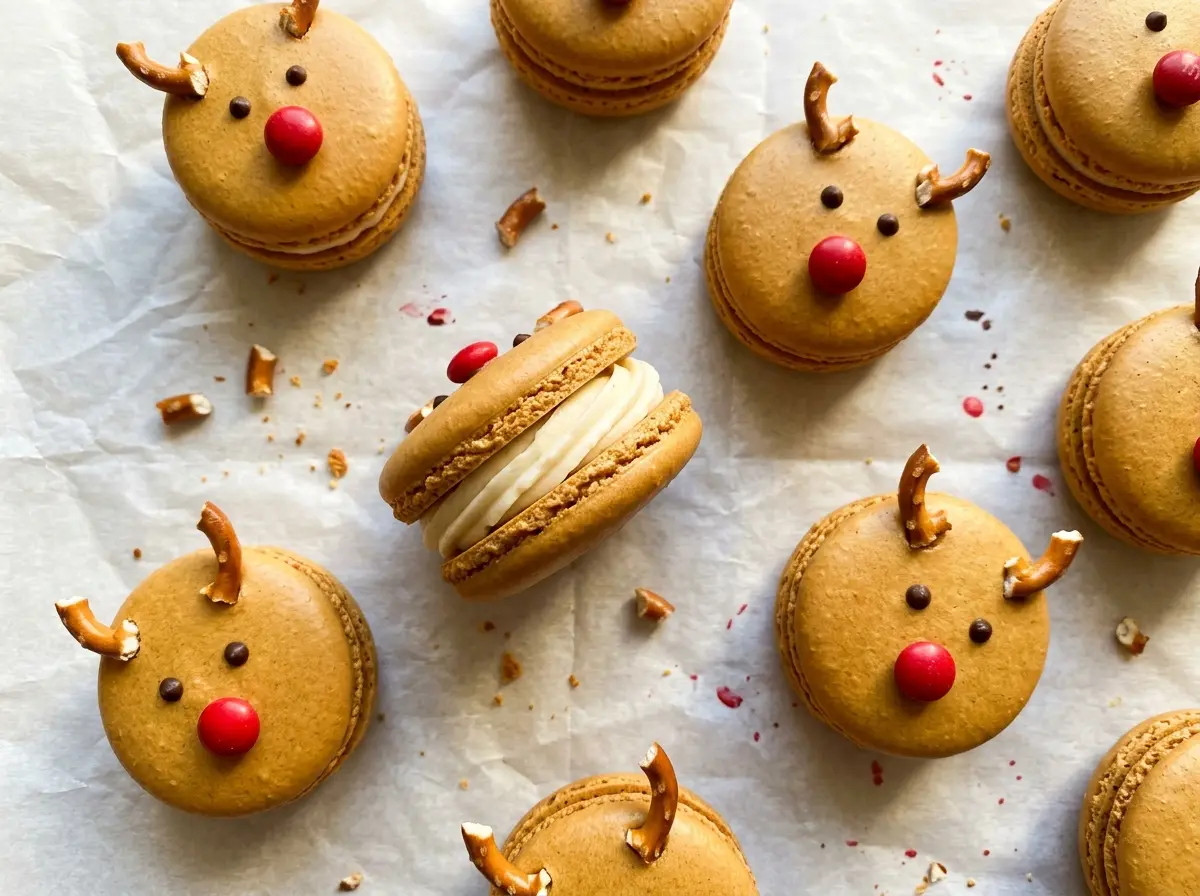
Stop folding when the batter falls from the spatula in a thick ribbon and sinks back in about 10–15 seconds. If it still sits in a mound, fold a little more; if it runs off like a stream, the batter has gone too far.
Save these Reindeer Macarons for a festive baking day: chocolate-filled shells, piped antlers, and a bright red candy nose on every one.
Why Macaron Shells Need a Dry Skin Before the Oven
The pause on the baking sheet is about the surface, not drying out the center. As the tops lose their tackiness, a thin skin forms; during baking, that surface helps the shells keep a smooth cap while the batter rises at the base and forms its feet. If the tops are still sticky when they go into the oven, they’re more likely to crack or bake unevenly.
Room conditions affect how quickly that skin forms, which is why the stand time is a range rather than a fixed minute. The fingertip test is more useful than guessing: a shell is ready when its top feels dry and doesn’t stick. Be gentle when checking; pressing hard can dent the uncooked surface. Once the tops pass that test, the shells are ready for the oven, where baking one sheet at a time gives each batch the same center-rack position.
That dry surface also helps the finished shells look polished enough for the reindeer faces. A few small imperfections are normal, but a smooth top gives the eyes, nose, and antlers a clean place to sit. Let the shells cool completely before peeling them from the parchment, since warm shells are delicate and can tear.
Almond Flour and Meringue: The Ingredients That Set the Shells

- Superfine blanched almond flour — Its fine texture gives the shells a smoother finish than coarse almond meal. Sift it with the powdered sugar and discard any larger bits left behind; almond meal isn’t a dependable swap when you want neat, even shells.
- Powdered and granulated sugars — Powdered sugar blends with the almond flour, while granulated sugar is beaten gradually into the egg whites. Keep them in their separate parts of the method; swapping one for the other changes how the meringue and dry mixture behave.
- Egg whites and cream of tartar — Room-temperature whites whip readily, and the bowl needs to be clean and grease-free for a stable meringue. Cream of tartar supports the whipped whites; there isn’t a simple replacement that gives this formula the same result.
- Brown gel food coloring — Gel gives the shells their warm color without adding much liquid to the batter. Beat it into the meringue until the color is even before folding in the almond mixture. Leaving it out gives you pale shells, not brown reindeer faces.
- Semisweet chocolate, heavy cream, and butter — Finely chopped chocolate melts more evenly under hot cream than large pieces do. Heavy cream gives the ganache its rich texture, and the butter is stirred in after the chocolate mixture turns smooth. Choose chocolate you enjoy eating; its taste carries through the filling.
- Decorating icing and candies — The brown icing does double duty as antlers and as the small dab that holds each candy eye and nose in place. The candies don’t need to be a particular brand; choose eyes and red mini candy-coated chocolates small enough to fit the shells.
From Glossy Peaks to a Pipeable Ganache
Sift the Dry Ingredients and Whip the Meringue
Heat the oven to 300°F and line two baking sheets with parchment paper. Sift the almond flour and powdered sugar together, discarding the coarse bits left in the sieve. In a clean, grease-free bowl, beat the room-temperature egg whites and cream of tartar until foamy, then gradually add the granulated sugar. Keep beating until the peaks are stiff and glossy, then beat in the brown gel coloring until it’s even.
Fold, Pipe, and Let the Tops Dry
Fold the almond flour mixture into the meringue in three additions, using the ribbon cue from the Kitchen Note to judge the batter. Transfer it to a piping bag fitted with a 1/2-inch round tip and pipe 1 1/2-inch rounds, about 1 inch apart. Tap each sheet firmly on the counter and pop visible air bubbles with a toothpick. Let the shells stand at room temperature for 30–60 minutes, until their tops feel dry and don’t stick to a fingertip.
Bake One Sheet at a Time
Bake one sheet at a time on the center rack for 14–16 minutes. Look for formed feet and tops that are set; don’t rely on color alone to judge the bake. Cool the shells completely on the baking sheet before carefully peeling them from the parchment.
Make the Ganache and Finish the Faces
Put the finely chopped chocolate in a heatproof bowl and warm the heavy cream in a small saucepan until steaming but not boiling. Pour the cream over the chocolate, let it stand for 2 minutes, then stir until smooth and stir in the butter. Refrigerate the ganache for 30–45 minutes, stirring every 10 minutes, until it’s thick enough to pipe. Pipe about 1 teaspoon onto the flat side of half the shells, top with the remaining shells, and press gently to spread the filling. Pipe two small antlers onto each macaron, then use small dabs of icing to attach two candy eyes and one red candy nose.
Three Ways to Change the Reindeer Macarons
Make a simpler chocolate-filled macaron
Leave off the decorating icing, candy eyes, and red noses after sandwiching the shells. You’ll keep the almond shells and chocolate center, but the result is a plain macaron with less decorating work and no reindeer face.
Use bittersweet chocolate for a darker filling
Replace the semisweet chocolate with the same amount of finely chopped bittersweet chocolate and make the ganache the same way. The filling tastes less sweet and more cocoa-forward; chill it until it’s thick enough to pipe before assembling.
Make the filling dairy-free
Use dairy-free semisweet chocolate and replace the heavy cream with the same amount of full-fat coconut cream; leave out the butter. The ganache will have a light coconut note. This changes the filling only: the shells still contain egg whites, so the macarons aren’t vegan.
Storage and Reheating
- Refrigerator: Keep the assembled macarons in an airtight container for their 12–24-hour rest. No longer storage window is included here.
- Freezer: Freezing isn’t part of this method, so there isn’t a tested freezing window to give.
- Reheating: Don’t reheat them. Bring the macarons to room temperature for about 20 minutes before serving.
Questions That Come Up While Making Reindeer Macarons
Reindeer Macarons
Ingredients
Equipment
Method
- Preheat the oven to 300°F and line two baking sheets with parchment paper.
- Sift the almond flour and powdered sugar together into a bowl, discarding any coarse bits left in the sieve.
- In a clean, grease-free bowl, beat the egg whites and cream of tartar until foamy.
- Gradually beat in the granulated sugar until stiff, glossy peaks form.
- Beat in the brown gel food coloring until evenly colored.
- Fold in the almond flour mixture in three additions until the batter falls from a spatula in a thick ribbon and sinks back in about 10–15 seconds.
- Transfer the batter to a piping bag fitted with a 1/2-inch round tip and pipe 1 1/2-inch rounds onto the prepared sheets, spacing them about 1 inch apart.
- Tap each sheet firmly on the counter and pop visible air bubbles with a toothpick.
- Let the shells stand at room temperature for 30–60 minutes, until the tops feel dry and do not stick to a fingertip.
- Bake one sheet at a time on the center rack for 14–16 minutes, until the shells have formed feet and the tops are set.
- Cool the shells completely on the sheet before carefully peeling them off the parchment.
- Put the chocolate in a heatproof bowl.
- Warm the heavy cream in a small saucepan until steaming but not boiling.
- Pour the cream over the chocolate and let stand for 2 minutes.
- Stir until smooth and stir in the butter.
- Refrigerate the ganache for 30–45 minutes, stirring every 10 minutes, until thick enough to pipe.
- Pipe about 1 teaspoon of ganache onto the flat side of half the shells.
- Top with the remaining shells and gently press to spread the filling.
- Pipe two small antlers with the brown decorating icing onto each macaron.
- Use small dabs of icing to attach two candy eyes and one red candy nose to each macaron.
- Refrigerate the macarons in an airtight container for 12–24 hours.
- Bring the macarons to room temperature for about 20 minutes before serving.


