
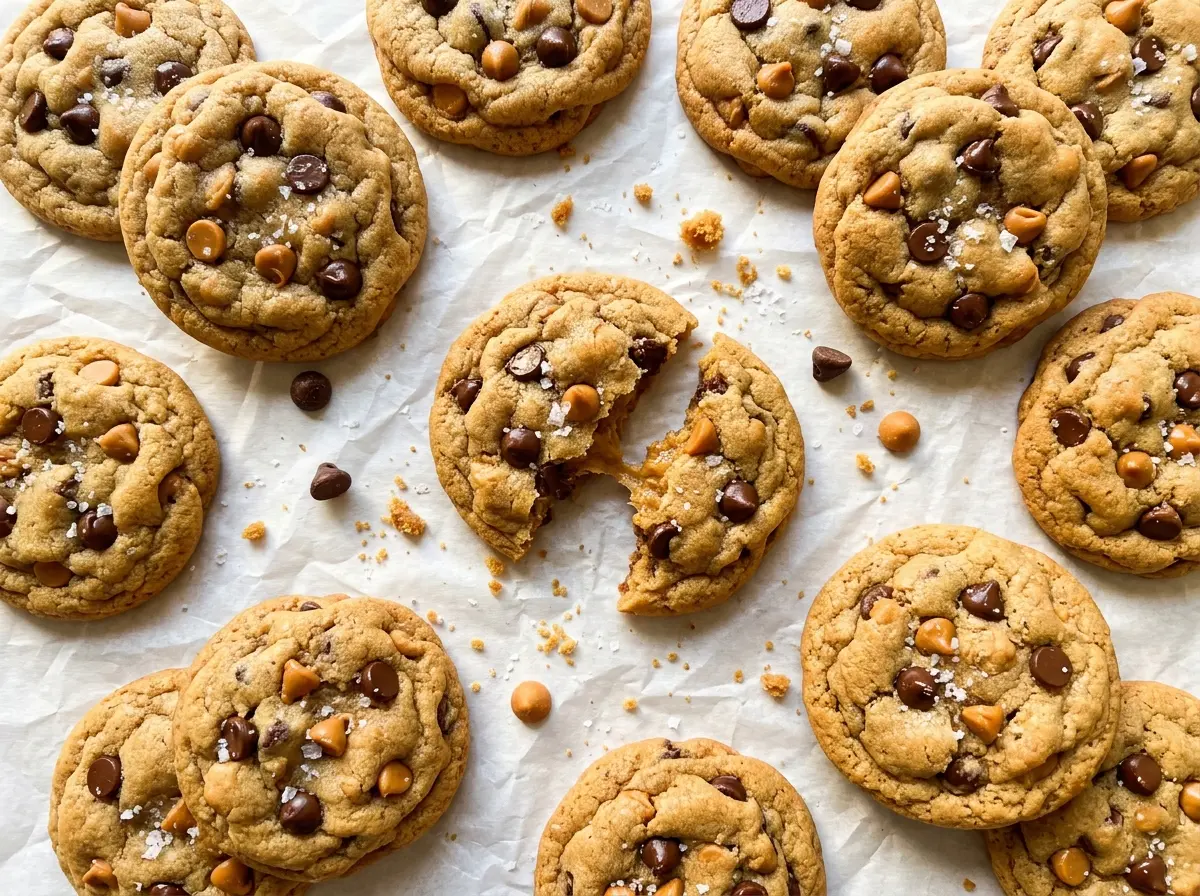
The first thing you notice is how quickly the butterscotch chips turn glossy at the edges while the chocolate stays in dark little pockets. Pull the pans when the cookie edges are golden but the centers still look soft; they’ll finish setting as they cool. That timing gives these butterscotch chocolate chip cookies with sea salt their contrast of crisp edges and tender centers.
I chill the dough for 30 minutes before portioning it. That pause firms the butter after mixing, which helps the cookies hold their shape instead of spreading too quickly in the oven. It also makes the dough easier to scoop into even portions.
The two kinds of chips keep each bite from tasting one-note, and a pinch of flaky sea salt on the warm tops sharpens the sweetness. Give the cookies five minutes on the baking sheets before moving them; they’re delicate straight from the oven, then settle into soft-centered cookies with crisp, golden edges.
Kitchen Note
Sprinkle the flaky salt over the cookies while they’re still warm. It clings to the tops much better than it does once the cookies have cooled.
Save these butterscotch chocolate chip cookies with sea salt for their golden edges, soft centers, and sweet-salty finish.
Why a 30-Minute Chill Helps These Cookies Stay Thick
Cookie dough made with softened butter is easy to mix and scoop, but warm, freshly mixed dough can spread fast once it hits the oven. Refrigerating it gives the butter time to firm back up. That’s useful here because each portion holds a generous amount of both kinds of chips, and a cookie that spreads too far can leave those chips crowded at the edges instead of distributed through the center.
Keep the dough covered for the full 30 minutes, then portion it into balls of about 3 tablespoons. The chill isn’t a reason to leave the dough out while the oven heats; the oven should already be at 350°F, and the lined pans should be ready when you start scooping. Give the portions room, too: arrange 12 on each baking sheet with at least 2 1/2 inches between them. That spacing leaves room for the cookies to spread without running together.
If your cookies come out wider than you expected, look at the dough temperature and spacing before changing the baking time. Starting with chilled dough and leaving space between portions are the two details this particular batch depends on for evenly shaped cookies.
What the Butterscotch, Chocolate, and Flaky Salt Each Bring

- Light brown sugar and granulated sugar — The brown sugar brings a deeper, molasses-like sweetness, while granulated sugar balances it and helps the cookies spread. Pack the brown sugar when measuring so the amount is consistent.
- Salted butter — Softened butter creams smoothly with the sugars and gives the dough its rich base. Use it softened, not melted; melted butter won’t cream into the same light mixture.
- Butterscotch and semisweet chocolate chips — The butterscotch chips add a concentrated caramel-like sweetness, while semisweet chocolate brings a darker, less-sweet contrast. Keeping both in the dough is what gives the cookies their two distinct pockets of flavor.
- All-purpose flour and baking soda — Flour gives the dough structure, and baking soda helps the cookies spread and brown. Whisk them together before adding them so the soda doesn’t sit in one spot in the finished dough.
- Eggs and vanilla extract — The eggs bind the dough and add moisture; adding them one at a time helps them blend into the creamed butter and sugar. Vanilla rounds out the sweetness without competing with the chips.
- Flaky sea salt — Its larger crystals give the tops a crisp, salty accent that table salt won’t quite replicate. Keep it for finishing rather than mixing it into the dough.
From Creamed Butter to Soft-Centered Cookies
Cream the Butter and Sugars Until Fluffy
Beat the softened salted butter with both sugars on medium speed for about 2 minutes. The mixture should look lighter and fluffy rather than dense or greasy. Scrape the bowl if butter or sugar is clinging to the sides so it gets incorporated. Starting with butter that’s too cold makes this step harder, while melted butter won’t build the same creamed texture.
Add the Eggs, Then Mix in the Dry Ingredients
Beat in the eggs one at a time, then mix in the vanilla. Whisk the flour and baking soda together in a separate bowl before adding them to the butter mixture. Mix on low speed just until no dry streaks remain; stopping there keeps you from working the dough more than it needs. Fold in both kinds of chips so they’re spread through the dough.
Chill, Portion, and Leave Room to Spread
Cover the dough and refrigerate it for 30 minutes. While it chills, heat the oven to 350°F and line two 18×13-inch rimmed baking sheets with parchment paper. Portion the dough into 24 balls, about 3 tablespoons each, and place 12 on each sheet with at least 2 1/2 inches between them. Crowding the pans gives spreading cookies too little room.
Rotate the Pans and Pull Them While the Centers Look Soft
Bake both sheets for 11–13 minutes, switching their positions and rotating them front to back halfway through. Look for golden edges and centers that still appear soft; waiting until the centers look fully firm in the oven can take the cookies past that tender middle. Sprinkle the warm cookies with flaky sea salt. Let them cool on the baking sheets for 5 minutes, then transfer them to a wire rack.
Small Finishing Changes That Keep the Cookie Base Intact
Make the Chip Tops More Visible
When portioning the dough, turn a few of the chips already in each ball toward the top. The ingredient amounts stay the same, but the baked cookies show more of their chocolate and butterscotch chips on the surface.
Give the Salt a More Pronounced Contrast
For a stronger sweet-salty finish, concentrate the flaky sea salt on fewer cookies rather than scattering it evenly across the whole batch. The salted cookies will taste more vivid beside the plain-topped ones, while the dough itself stays unchanged.
Storage and Reheating
- Refrigerator: Keep the cookies in an airtight container at room temperature for up to 4 days; refrigeration isn’t needed and can make them firm.
- Freezer: Freeze fully cooled cookies in an airtight freezer container for up to 2 months. Separate layers with parchment so the cookies don’t stick together.
- Reheating: Warm a cookie briefly in the microwave if you want the chips soft again. Use short bursts; heating too long can make the cookie tough and the chips overly hot.
Questions That Come Up When Baking These Butterscotch Cookies
Butterscotch Chocolate Chip Cookies with Sea Salt
Ingredients
Equipment
Method
- Heat the oven to 350°F and line two 18x13-inch rimmed baking sheets with parchment paper.
- Whisk the flour and baking soda together in a medium bowl.
- Beat the butter, brown sugar, and granulated sugar in a large bowl on medium speed until light and fluffy, about 2 minutes.
- Beat in the eggs one at a time.
- Beat in the vanilla extract.
- Mix in the flour mixture on low speed just until no dry streaks remain.
- Fold in the butterscotch chips and chocolate chips.
- Cover the dough and refrigerate for 30 minutes.
- Portion the dough into 24 balls, about 3 tablespoons each.
- Arrange 12 on each baking sheet, leaving at least 2 1/2 inches between them.
- Bake both sheets for 11–13 minutes, switching their positions and rotating them front to back halfway through, until the edges are golden and the centers still look soft.
- Sprinkle the warm cookies with the flaky sea salt.
- Let them cool on the baking sheets for 5 minutes.
- Transfer them to a wire rack to cool.


