
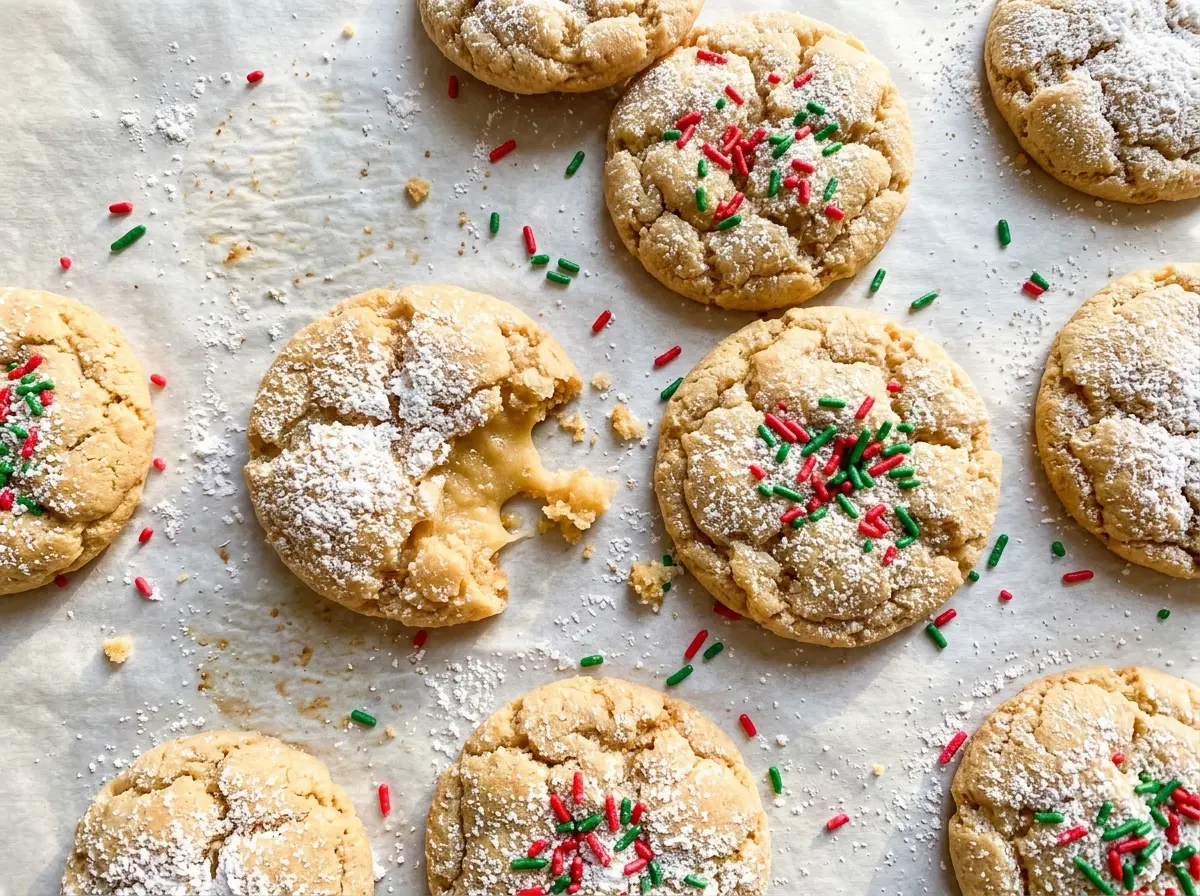
The dough feels softer and stickier than a regular cookie dough when it first comes together, so don’t be tempted to add flour. A full hour in the refrigerator changes everything: it firms up enough to roll neatly, and the powdered sugar clings in a thick white coat. That’s how I get Christmas Gooey Butter Cookies with their soft centers and snowy, crinkled tops.
Cream cheese and butter make these cookies tender, while yellow cake mix keeps the ingredient list short and gives the dough its structure. I fold in the red and green jimmies after the mix is combined, so the colors stay scattered through the dough instead of getting beaten into it. The edges set in the oven while the middle stays soft, and the cookies finish settling on the baking sheet.
Kitchen Note
Give the dough its full hour in the refrigerator, until it feels firm when you press it gently. Warm dough is hard to roll cleanly, and the powdered sugar won’t coat the balls as evenly.
Save these Christmas Gooey Butter Cookies for a holiday bake: soft centers, snowy powdered-sugar tops, and bright red and green sprinkles.
Why These Gooey Cookies Don’t Need Extra Flour
When soft dough sticks to your fingers, adding flour seems like the obvious fix. Here, it changes the balance that makes the centers tender. The yellow cake mix is the complete dry base; it brings the flour and other dry ingredients the dough needs without measuring them separately. Adding more flour to make the dough feel like a traditional cookie dough can leave the baked cookies dense instead of gooey.
The cream cheese and butter also make this dough softer than a standard butter-and-sugar cookie dough. That softness is part of the result, not a sign that the mixture is missing something. Once the dough is chilled, scoop and roll it without working in extra dry ingredients. The thick powdered-sugar coating gives the outside its snowy finish, while the inside stays soft.
Keep the mixing gentle once the cake mix goes in. Mixing just until there are no dry patches gives you an evenly combined dough without beating the sprinkles into streaks. You’ll see the red and green pieces throughout each cookie, framed by the white sugar coating.
What the Cake Mix, Cream Cheese, and Jimmies Each Bring

- Cream cheese — Use softened block cream cheese for a smooth, sturdy dough. Block-style cream cheese gives a more reliable texture than whipped or spreadable cream cheese from a tub. A standard grocery-store brand works well; let it soften enough to beat smoothly with the butter.
- Unsalted butter — Softened butter blends evenly with the cream cheese and helps make the centers tender. Regular butter is all you need here; unsalted keeps the overall salt level more predictable alongside a boxed mix. If you only have salted butter, the cookies will taste a little saltier.
- Large egg — The egg helps bind the dough and gives it structure as it bakes. Stick with a large egg so the wet-to-dry balance stays close to the intended dough texture.
- Vanilla extract — Vanilla rounds out the buttery, sweet dough without taking over. Pure or imitation vanilla both work; there’s no need to use an expensive bottle in a cookie with several other strong ingredients.
- Yellow cake mix — The mix is the dough’s entire dry foundation, so use a standard yellow cake mix in the listed package size rather than adding extra flour or choosing a much smaller box. A familiar supermarket brand is fine; the package size matters more than the brand name.
- Red and green jimmies — Jimmies are long sprinkles that fold easily into the thick dough and give each cookie festive color. Choose the colors you like, but avoid swapping in liquid coloring if you want distinct sprinkle pieces throughout.
- Powdered sugar — This is the outside coating, not a replacement for granulated sugar in the dough. A generous coating gives the cookies their white finish; ordinary powdered sugar from the baking aisle works well.
Mixing and Baking the Dough Without Losing the Soft Centers
Beat the Cream Cheese and Butter Smooth
Beat the softened cream cheese and butter in a large bowl with an electric mixer until the mixture looks smooth. Add the egg and vanilla, then beat them in until the wet mixture is combined. If you start with cold cream cheese, small lumps are harder to smooth out, so allow it to soften first. Scrape the bowl if needed to bring any unmixed cream cheese into the mixture.
Fold in the Jimmies, Then Chill
Mix in the yellow cake mix on low speed and stop when no dry patches remain. The dough will be soft; don’t keep beating after it comes together. Fold in the red and green jimmies so they stay visible rather than breaking up under the mixer. Cover the bowl and chill the dough for 1 hour, until firm.
Roll and Coat Each Portion
Heat the oven to 350°F and line a large baking sheet with parchment paper. Scoop the dough into 1 1/2-tablespoon portions and roll each portion between your hands into a ball. Roll the balls generously in powdered sugar so the dough is covered all over. If the coating looks thin or patchy, roll the ball through the sugar again before setting it on the sheet.
Bake Until the Edges Set
Arrange the dough balls about 2 inches apart and bake in batches for 10–12 minutes. Look for edges that have set while the centers remain soft; don’t wait for the middle to look firm in the oven. Let the cookies cool on the baking sheet for 5 minutes, then transfer them to a wire rack. Moving them too soon can break the tender cookies before they’ve had a chance to settle.
Easy Ways to Change the Flavor or Make a Gluten-Free Batch
Turn Them Into Chocolate Gooey Butter Cookies
Replace the yellow cake mix with a 15.25-ounce chocolate cake mix and keep the other ingredients and method the same. The cookies will have a chocolate base beneath the powdered-sugar coating; red and green jimmies still give them a holiday look.
Use a Gluten-Free Yellow Cake Mix
For a gluten-free version, use a 15.25-ounce gluten-free yellow cake mix in place of the regular mix. Keep the remaining ingredients and steps unchanged. The dough may feel a little different depending on the mix, but chilling it until firm makes it easier to portion and roll.
Storage and Reheating
- Refrigerator: Keep cooled cookies in an airtight container for up to 5 days. The powdered-sugar coating may absorb moisture and look less crisp over time.
- Freezer: Freeze cooled cookies in an airtight container for up to 2 months, with parchment between layers. Thaw before serving.
- Reheating: Warm an individual cookie in the microwave for about 5–8 seconds if you’d like a softer, warm center. Longer heating can make the edges tough, so use a short burst.
Questions That Come Up While Making Gooey Butter Cookies
Christmas Gooey Butter Cookies
Ingredients
Equipment
Method
- In a large bowl, beat the cream cheese and butter with an electric mixer until smooth.
- Beat in the egg and vanilla.
- Mix in the cake mix on low speed until no dry patches remain.
- Fold in the jimmies.
- Cover and chill the dough for 1 hour, until firm.
- Heat the oven to 350°F and line a large baking sheet with parchment paper.
- Scoop the dough into 1 1/2-tablespoon portions and roll each into a ball.
- Coat each dough ball generously in powdered sugar.
- Arrange the dough balls about 2 inches apart on the baking sheet.
- Bake in batches for 10–12 minutes, until the edges are set and the centers remain soft.
- Cool on the baking sheet for 5 minutes, then transfer to a wire rack.


