
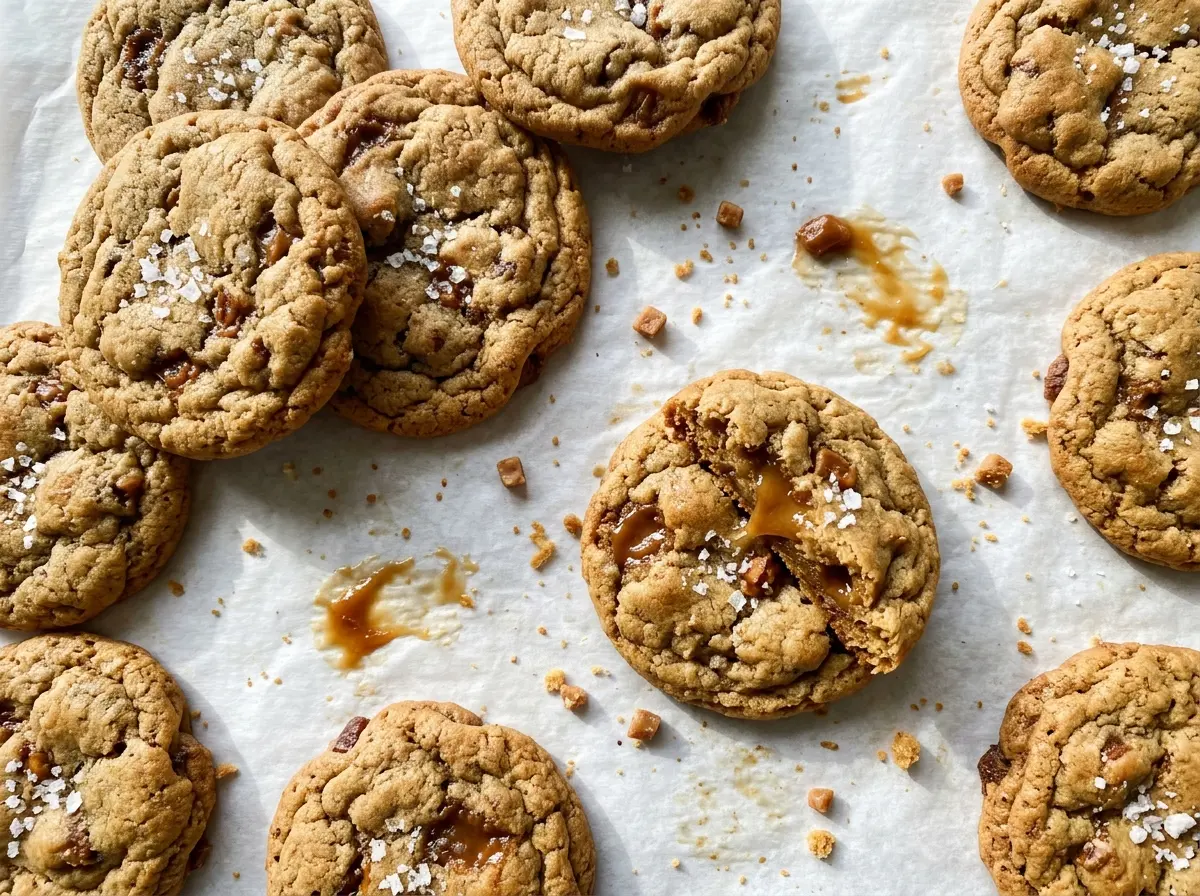
The first tray gives you two different textures in one bite: the caramel bits soften into sweet pockets, while the toffee keeps a little crunch. I learned not to wait for the centers to look fully baked before pulling these Salted Caramel Toffee Cookies from the oven. Their edges should be golden, but the middles still look a touch soft.
The dough has both brown and granulated sugar, so the cookies get a chewy middle and gently crisp edges without losing their buttery character. A whole egg and an extra yolk help keep the centers tender, and a short rest in the refrigerator makes the dough easier to portion. Flaky salt goes on while the cookies are hot, where it catches on the surface instead of falling off. Break one open after it cools a little, and you’ll find caramel, toffee, and a salty finish in every bite.
Kitchen Note
Softened butter should give when you press it, but it shouldn’t look shiny or partly melted. Butter that’s too warm can leave the dough greasy before it even reaches the oven.
Save these Salted Caramel Toffee Cookies for chewy centers, crisp toffee bits, and a flaky-salt finish.
Why the Centers Should Still Look Soft When the Edges Turn Golden
Caramel and toffee cookies can be tricky to judge by color alone. The bits add plenty of sweetness, so it’s natural to think the centers need extra time to bake through. That’s how you end up with a firm, dry cookie instead of a chewy one. These cookies keep setting after they leave the oven, while they rest on the warm baking sheet.
Look at the edge and the middle separately. Golden edges tell you the outside has baked; a slightly underdone-looking center is the cue to take the pan out. The cookies rest on the sheet for five minutes before moving to a rack, which gives the centers time to settle without baking them as hard as they would in the oven. If the middle already looks completely firm when you pull the tray, it’s likely to lose that soft contrast as it cools. Trust the color at the edge, not a uniformly browned top.
What the Sugars, Bits, and Finishing Salt Each Bring

- All-purpose flour — It gives the dough enough structure to hold the caramel and toffee bits in place. Keep to all-purpose flour here; a different flour can change how the dough absorbs moisture and spreads. A standard bag works well, so there’s no need for specialty flour.
- Light brown and granulated sugars — Brown sugar brings moisture and a deeper, molasses-like note, while granulated sugar helps the edges bake up with a little crispness. The packed brown sugar matters because loose measuring changes the balance; ordinary granulated sugar is fine.
- Unsalted butter — Butter carries the rich flavor and helps the sugars cream into a smooth base. Unsalted butter lets the fine salt in the dough stay in balance. I wouldn’t replace it with melted butter or oil, which changes the dough’s texture and spread.
- The egg and extra yolk — The whole egg supplies moisture and structure, and the yolk adds richness without bringing in another egg white. Both should be at room temperature so they blend into the creamed butter and sugar without leaving the mixture uneven.
- Caramel bits and toffee bits — They aren’t interchangeable: the caramel brings soft, sweet pockets, and the toffee contributes a firmer, buttery crunch. Use bits intended for baking so they’re easy to fold through the dough. Chopping or changing the inclusions will give you a different distribution and bite.
- Fine salt and flaky sea salt — Fine salt seasons the dough evenly, while flaky sea salt stays noticeable on top. The finishing salt’s larger flakes give a crisp little burst that fine salt can’t reproduce, so keep the two roles separate.
Mixing and Baking the Dough Without Losing the Chewy Middle
Whisk the Dry Mix, Then Cream the Sugars
Whisk the flour, baking soda, and fine salt together in a medium bowl so the leavener is spread through the flour before it reaches the dough. In a large bowl, beat the softened butter with both sugars on medium speed for about two minutes. The mixture should look creamy rather than oily or separated. If flour pockets remain in the dry mix, whisk them out before moving on; they’re harder to incorporate once the butter is in the bowl.
Add the Eggs, Flour, and Cookie Bits
Beat in the egg and egg yolk until combined, then mix in the vanilla. Add the flour mixture in two additions, mixing on low just until it disappears; stop before the dough turns tough from overmixing. Fold in the caramel bits and toffee bits so they’re scattered throughout instead of gathering at the bottom. Scrape the sides and bottom of the bowl as you fold, where stray flour or bits can hide.
Chill, Then Portion the Dough
Cover the dough and refrigerate it for 30 minutes. While it chills, heat the oven to 350°F and line an 18×13-inch rimmed baking sheet with parchment paper. Scoop the dough into 24 portions, about 2 tablespoons each, and arrange 12 on the sheet at least 2 inches apart. Keep the remaining portions chilled while the first batch bakes so they stay firm and easy to handle.
Bake Until the Edges Are Golden
Bake the first batch for 10–12 minutes, watching for golden edges and centers that still look slightly underdone. Sprinkle the cookies with flaky sea salt as soon as they come out, then let them rest on the sheet for 5 minutes before transferring them to a wire rack. The baking sheet needs to cool completely before you arrange the remaining dough on it; a warm sheet can start softening the dough before it goes into the oven. Bake the second batch for 10–12 minutes and finish it the same way.
Three Small Changes for a Different Caramel-Toffee Balance
Make the Caramel the Main Event
Leave out the toffee bits and keep the caramel bits. The cookies will have fewer crunchy bites and a sweeter, more caramel-forward taste, while the dough still has the same base and portion size.
Let the Toffee Lead
For a less gooey, more buttery crunch, leave out the caramel bits and keep the toffee bits. You’ll lose the soft caramel pockets, but the toffee flavor comes through more clearly in each bite.
Keep the Finish Sweet Instead of Salty
Skip the flaky sea salt on top and leave the fine salt in the dough. The cookies will still have balanced seasoning, but you won’t get the little salty crunch against the caramel.
Storage and Reheating
- Refrigerator: These cookies don’t need refrigeration. Keep them in an airtight container at room temperature for up to 5 days; refrigeration firms them up.
- Freezer: They freeze well once fully cooled. Seal them in an airtight freezer container for up to 2 months, then thaw at room temperature.
- Reheating: Warm cookies in a 300°F oven for 3–4 minutes if you’d like the caramel soft again. Don’t heat them until the caramel is bubbling; it gets extremely hot.
Questions That Come Up When Baking Salted Caramel Toffee Cookies
Salted Caramel Toffee Cookies
Ingredients
Equipment
Method
- Whisk the flour, baking soda, and fine salt together in a medium bowl.
- Beat the butter, brown sugar, and granulated sugar in a large bowl with an electric mixer on medium speed until creamy, about 2 minutes.
- Beat in the egg and egg yolk until combined.
- Mix in the vanilla extract.
- Add the flour mixture in two additions, mixing on low just until combined.
- Fold in the caramel bits and toffee bits.
- Cover and refrigerate the dough for 30 minutes.
- Heat the oven to 350°F.
- Line an 18x13-inch rimmed baking sheet with parchment paper.
- Scoop the dough into 24 portions, about 2 tablespoons each.
- Arrange 12 portions at least 2 inches apart on the baking sheet and keep the rest chilled.
- Bake the first batch for 10–12 minutes, until the edges are golden and the centers still look slightly underdone.
- Immediately sprinkle the cookies with flaky sea salt.
- Let the cookies rest on the sheet for 5 minutes.
- Transfer the cookies to a wire rack.
- Cool the baking sheet completely before baking the remaining dough.
- Bake the remaining dough for 10–12 minutes, until the edges are golden and the centers still look slightly underdone.
- Immediately sprinkle the remaining cookies with flaky sea salt.
- Let the cookies rest on the sheet for 5 minutes.
- Transfer the cookies to a wire rack.


